Press Release: Leveraging PA, WV Trails for Regional Benefit
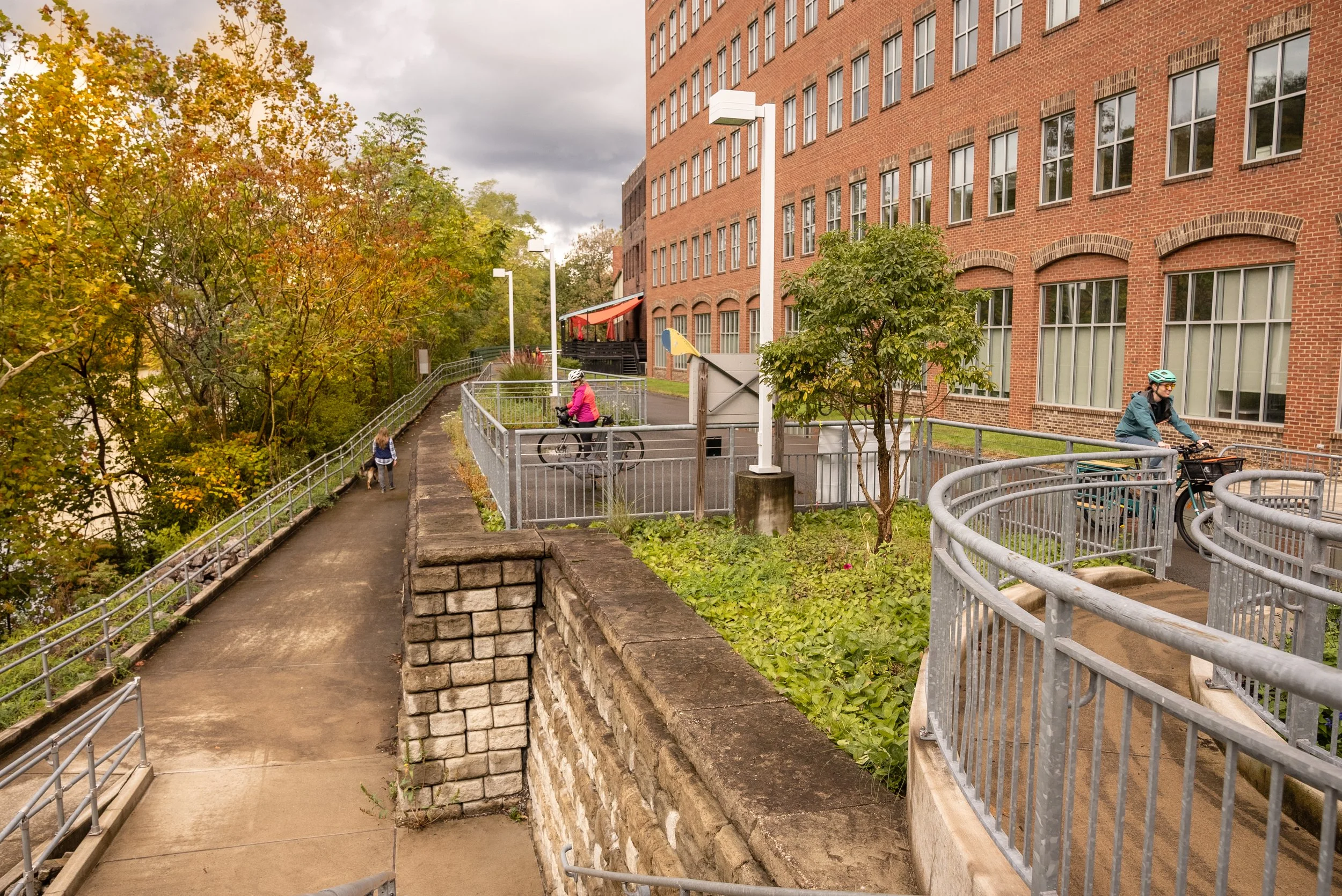
Photo courtesy: Rails to Trails Conservancy by Renee Rosensteel
Input Needed for P2P Trail Corridor Community & Economic Planning Effort
WASHINGTON, PA – The National Road Heritage Corridor (NRHC) and seven partner organizations have launched a major regional planning effort to unlock the community and economic potential of the Parkersburg to Pittsburgh (P2P) Trail Corridor. The partners are calling on residents, local leaders, business owners, and trail users across the two-state region to help shape the future of this nearly complete 238-mile trail system.
“Trails have the potential to bring business to a region, but not without planning, partnerships, and community input,” says Sarah Collier, Executive Director of the NRHC "This economic and community development plan will outline how we can make that happen for the Parksburg to Pittsburgh trail network.”
Kent Spellman, project partner and Co-Chair of WV TRAIL, echoed the need for intentional action. “The economic development hasn’t materialized the way we’d hoped along some portions of the P2P corridor. We need to be more intentional in leveraging the outdoor economy, as has been done along the Great Allegheny Passage and other trails throughout Appalachia,” Spellman said. “This process provides the opportunity to engage communities in planning for a future in which trails and outdoor recreation make a measurable difference in local life.”
Map courtesy Rails to Trails Conservancy
About the Project
The effort is funded through a multi-state Appalachian Regional Commission (ARC) ARISE grant designed to position a nine-county region in Pennsylvania and West Virginia to fully leverage the P2P Trail Corridor for community and economic benefit. The ARC ARISE project profile can be viewed here.
The $145,500 ARC grant, combined with $140,000 in matching support from the Just Transition Fund, Claude Worthington Benedum Foundation, and the City of Fairmont, will support development of a regional master plan spanning eight trail systems:
Together, these trails will form a continuous non-motorized route from Parkersburg to Pittsburgh and contribute to the larger Industrial Heartland Trails Coalition network.
Project partners include the City of Fairmont, Great Allegheny Passage Conservancy, Harrison Recreation Trails, Inc., Monongahela River Trails Conservancy, Morgantown Riverfront Revitalization Task Force, National Road Heritage Corridor, Pennsylvania Environmental Council, and WV TRAIL, Inc.
Community Engagement Opportunities
Following a fall Request for Proposals, the partners selected Cycle Forward to lead the planning process, which will include extensive public engagement. Opportunities will roll out across 2026 and include:
Virtual topical discussions
In-person meetings in each participating county
A series of indoor and outdoor trail events throughout February as part of “Heart Trails Month”
The planning team will also conduct a mile-by-mile asset inventory to identify development opportunities, explore improved connections between trail corridors and downtowns, and develop both economic development and marketing strategies. The final regional master plan will guide future investment and strengthen long-term coordination across the network.
To receive updates, sign up at www.p2ptrails.org. Anyone interested in hosting a Heart Trails Month program—trail walks, educational talks, film screenings, or even Valentine-making for trails—may contact Amy Camp, Cycle Forward, at amy@cycleforward.org or 412-918-6563.
Building on Previous Work
This project builds on two 2018 feasibility studies: the Sheepskin Trail Feasibility Study and Connecting Parkersburg to Pittsburgh by Rail-Trail. The new effort expands the lens beyond trail construction to include the broader community and economic development potential of the P2P Trails system.
About the Appalachian Regional Commission (ARC)
The Appalachian Regional Commission (www.arc.gov) is an economic development partnership agency of the federal government and 13 state governments, supporting 420 counties across the Appalachian Region. ARC’s mission is to innovate, partner, and invest to build community capacity and strengthen economic growth in Appalachia.